
Considering a kitchen or bathroom renovation but terrified of the chaos and disasters you’ve heard about?
Worried about hiring a team who’ll disappear, leave your home in a mess, or botch the installation?
You’re right to be cautious.
This guide exposes the genuine problems that arise during renovations and explains exactly how professional teams prevent, manage, and resolve them.
You’ll discover the critical difference between legitimate challenges and cowboy builder tactics.
What You’ll Learn
- Why the fears 50 Cranleigh homeowners shared are completely valid
- The specific protocols that protect your home from dust and damage
- How to spot the difference between normal delays and red flags
- What bathroom leaks actually stem from and prevention methods
- The questions that identify truly trustworthy builders versus risks
- When choosing a cheaper option creates more problems than it solves
Our goal is to educate you. You can then make the best decision, even if that means you don’t buy from us.
7 Renovation Problems That Cost Surrey Homeowners Thousands (And How to Prevent Each One)
- The 4 fears that derail 80% of renovations
- Problem #1: Timeline delays and disappearing builders
- Problem #2: Dust, mess, and home violation
- Problem #3: Trust and safety concerns
- Problem #4: Communication breakdowns
- Problem #5: The leak disaster
- Problem #6: Unforeseen cost spirals
- Problem #7: Guarantee confusion
- When problems signal professionalism
- Who this approach is NOT for
- Quick reference to all articles
What Do We Mean by “Renovation Problems”?
Renovation problems are the genuine challenges, risks, and failures that occur during kitchen and bathroom refurbishments—from minor inconveniences to catastrophic disasters costing £10,000+.
Understanding them helps you choose teams that prevent rather than create chaos.
The 4 Fears That Derail 80% of Renovations (And What to Do About Each One)
In our experience helping homeowners since 2005, we see the same four fears repeatedly.
Chaos and Disruption. The dread of your home becoming a dusty, chaotic building site.
Financial Uncertainty. The terror of costs spiralling beyond your control.
Lost Control. Feeling overwhelmed by managing multiple trades and schedules.
Betrayal. The deep fear of hiring a cowboy builder you can’t trust.
These aren’t irrational worries. They’re based on the building trade’s unfortunate reputation.
Each fear is valid. Each has a specific solution.
Problem #1: Timeline Delays and the “Disappearing Builder”
Projects rarely run exactly to schedule. The question is whether delays are minor inconveniences or catastrophic abandonments.
Legitimate delays include:
Supplier delivery issues. A bespoke unit might arrive three days late.
Weather affecting drying times. Damp British conditions can add a day to the schedule.
Unforeseen structural problems. Rotten joists can’t be tiled over safely.
These are manageable. A professional team communicates immediately and adapts the schedule.
Red flags look different:
The “disappearing act” means your fitter doesn’t show up for three days. Calls go to voicemail. No explanation arrives.
This signals a single point of failure—a sole trader who is potentially juggling too many jobs.
When you’re without a functioning kitchen, understanding what problems and delays are normal becomes essential.
The professional solution
Team-based reliability eliminates the single point of failure. If one fitter is unwell, another skilled team member can normally step in.
With us, there’s a very good chance we can pull another fitter in. We keep continuity going.
When someone’s without a kitchen, that’s a massive attraction.
Project management handles supplier issues. When kitchen orders arrive damaged or with missing items, we re-sequence work—installing base units while waiting for wall units. The project keeps moving.
Problem #2: The Chaos Factor (Dust, Mess, and Sanctuary Violation)
Your home is your sanctuary. The thought of it becoming a building site can be deeply stressful.
The legitimate reality
Renovation is messy work. Ripping out old tiles creates dust. Cutting timber creates sawdust. This is unavoidable.
The difference is how it’s managed.
Unnecessary chaos comes from:
Disrespectful builders who leave rubble in corners and track mud through hallways. They don’t seal off the workspace, so dust migrates into bedrooms and wardrobes. They save all cleaning for the final day, leaving you to live in squalor for weeks.
Professional protocols include:
Physical isolation. Heavy-duty plastic barriers seal the room. Carpet protectors shield thoroughfares from the front door to the workspace. Specialist adhesive film prevents muddy boot marks.
Daily discipline. The workspace is vacuumed every single evening. We aim to leave your home cleaner than we found it.Detailed protection protocols explain exactly how this works.
Pat and Brian Crowther from Haslemere braced themselves for chaos. Instead, they described the experience as a “pleasure.”
They specifically noted “no mess” despite a full bathroom renovation. They went on to say that our fitter Ben was quiet and polite throughout.
That’s the standard we aim for.
Problem #3: Trust and Safety (Who Is in Your Sanctuary?)
Handing over your keys is a massive leap of faith. You’re inviting strangers around your family, pets and valuables.
This fear is valid
The South East sees high numbers of rogue trader reports. Horror stories are real.
We once witnessed an elderly couple mistreated by a rogue plumber. The work he had done was diabolical.
Seeing their distress cemented our belief. Respect isn’t optional; it’s foundational.
The trust gap exists because:
Low barriers to entry mean anyone can call themselves a builder. No vetting exists by default. Casual subcontractors rotate through projects – you never know who’s arriving. Character isn’t prioritised; technical skill alone doesn’t guarantee respectful behaviour.
Professional vetting addresses this:
- We hire for character first, skill second. Integrity is hard to teach.
- All our fitters are DBS checked. This government screening provides baseline safety.
- We’re members of the Guild of Master Craftsmen. Professional bodies require codes of conduct.
- Our team is stable and consistent.
Understanding who will be in your home and how to verify trustworthiness transforms anxiety into confidence.
Problem #4: The Silent Treatment (Communication Breakdowns)
Poor communication creates anxiety even when work is progressing fine. The unreturned call is a trust killer.
The information vacuum happens when:
Sole traders are on tools all day and do paperwork at night. No office team exists. You call a mobile that goes to voicemail. Reactive communication dominates—you have to chase for updates.
Gold-standard communication includes:
Proactive regular updates before you ask. When away, you receive video progress reports via WhatsApp.
Management site visits every 48 hours. Jamie, Liam, or Mark physically inspect quality.
“Vanguarding” anticipates disruption. You’re warned the water goes off at 2pm, not surprised mid-shower.
Dedicated office support. Victoria or Shannon answering your calls and responding to your e-mails.Effective day-to-day communication removes the stress of wondering what’s happening.
Annabel Haddock faced several supply hiccups. Her delivery dates shifted which meant that starting times had to change.
She described our install as effortless. She noted that we responded to emails immediately, even out of hours.
Problem #5: The Leak Disaster (Waterproofing Failures)
This is the most expensive problem to fix later. A slow leak can cause £10,000+ damage.
The three main causes:
Inadequate waterproofing allows water through grout. Standard plasterboard behind tiles can act as a sponge.
Floor movement breaks seals. Bouncy subfloors cause silicone to tear away or grout lines to crack.
Poor plumbing connections drip inside walls. Unchecked joints can leak for months unnoticed.
Prevention methods:
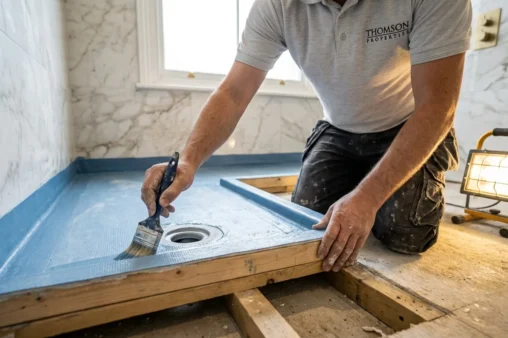
British Standard tanking membranes create a waterproof barrier. We apply this before tiling all wet areas.
Rigid substrate preparation eliminates bounce. Plywood and cement boards (or a decoupling mat) replace flexible timber.
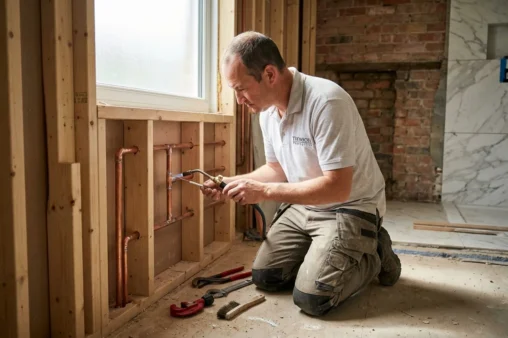
Pressure testing identifies leaks early. We cap the system and check joints before concealing pipework.
The detailed science of what causes bathroom leaks and prevention methods explains the critical unseen work.
| Leak Cause | Amateur Approach | Professional Prevention |
|---|---|---|
| Water through grout | Tile directly onto plasterboard | Apply tanking membrane first |
| Movement cracks | Ignore subfloor / subwall bounce | Replace with rigid substrate or lay a decoupling mat |
| Pipe joints fail | Hide without testing to try save time | Pressure test before concealing |
| Seal tears | Apply silicone to empty bath | Fill bath first, seal under load |
Problem #6: The Unforeseen Cost Spiral
This is the budget blowout fear. A £15,000 quote becomes £25,000 with “extras.”
Distinguishing legitimate from illegitimate:
Legitimate unforeseen issues are physically impossible to see beforehand. Rotten joists hide under old baths. Ancient lead pipes lurking behind tiles. Unsafe wiring runs through walls.
These must be fixed. A professional fitter cannot tile over structural rot.
Illegitimate surprises stem from vague quotes. “Labour and materials – £8,000” hides what’s included. Rubbish removal appears as a £400 surprise. Standard installation materials weren’t priced in.
Our transparent process:
We operate a “No Surprises” protocol detailed in our Charter Document.
If we find significant unforeseen issues, we stop. We inform you immediately with photos or video.
We provide a written quote. The exact cost for labour and materials is specified.
We wait for approval. We only proceed after receiving your written consent.
You stay in control. No surprise bills appear on the final invoice.Understanding typical hidden extras and what constitutes a fair payment schedule protects your budget.
| Issue Type | Professional Response | Cowboy Response |
|---|---|---|
| Rotten joist discovered | Stop, photograph, quote £520+VAT, get consent | Patch it, hide it, £800 surprise on final bill |
| Old wiring unsafe | Stop, explain risk, quote repair, get approval | Ignore it, connect anyway, fire risk later |
| Delivery damaged | Re-sequence work, keep project moving | Down tools, leave you waiting, charge for delay |
Problem #7: Guarantee Confusion (What’s Actually Protected)
For a guarantee to be valuable, you need to understand what it covers. Confusion leads to disputes.
The two pillars:
Manufacturer warranties cover product defects. If your shower valve fails due to a factory fault, that’s the manufacturer’s responsibility.
Workmanship guarantees cover installation quality. If tiles fall off due to incorrect adhesive, that’s the installer’s responsibility.
Common inclusions:
Leaks from poorly fitted joints. Loose basins from incorrect fixings. Tiles falling due to poor application. Grout cracking from rushed work.
Standard exclusions:
Normal wear and tear (silicone discolouring after three years is expected). Accidental damage (dropping a bottle that cracks a sink). Pre-existing issues (old pipework we didn’t replace that subsequently leaks).
Detailed guarantee coverage and exclusions clarifies exactly where you stand.
Why we offer three years
The industry standard is twelve months. We offer three years on all new installations.
Our character first, skill second hiring philosophy gives us confidence. We trust our team’s integrity.
Our focus on unseen quality means we rarely get called back. The work is done right initially.
When ‘Problems’ Actually Mean You’ve Hired the Right Builder
Discovering a rotten joist isn’t a disaster. It’s proof your fitter is thorough and honest.
The professional response test:
A cowboy builder often hides problems—patching over rot and hoping you don’t notice. Over and above this, they surprise you with bills.
A professional builder stops work. They show you the problem with photos. They explain the implications clearly. They quote the fix transparently. They wait for your approval. They document everything in writing.
When things go wrong, character reveals itself.
5 Questions That Expose Bad Builders Before You Sign
Before hiring anyone, ask these specific questions. Their answers reveal everything.
Question 1: Are all your team DBS checked?
Listen carefully. Dismissing it as unnecessary can be a red flag. Professional companies vet everyone. Your safety isn’t negotiable.
Question 2: What happens if the fitter is sick?
You want to hear about backup systems. A sole trader has no answer. A team-based company has resources.
Question 3: Describe your daily cleaning routine.
Generic promises don’t count. You need specific protocols—carpet protectors, vacuum routes, tool organisation. Details matter.
Question 4: What’s your process for unforeseen costs?
Vague answers are dangerous. You need a defined protocol: stop work, show problem, quote in writing, get consent. That’s professional.
Question 5: Can I speak to your last three clients?
Hesitation is a red flag. Confident companies offer references immediately. Better yet, they offer site visits.Finding a builder who respects your home starts with asking the right questions.
The 5-Point Matrix That Prevents Costly Renovation Disasters
| Risk | What Causes It | Professional Prevention | Potential Cost If It Fails |
|---|---|---|---|
| Catastrophic leak | No tanking membrane, untested joints | British Standard waterproofing, pressure testing | £1,000-£15,000+ ceiling/joist repair and rectifying associated damage |
| Project abandonment | Sole trader illness/emergency | Team backup, project continuity guarantee | Weeks without facilities, legal costs |
| Cost blowout | Vague quote, no process | Itemised estimate, written consent protocol | 30-50% over original budget |
| Unsafe work | No qualified electrician | Registered electricians, certification | Invalidated insurance, fire risk |
| Dust damage | No protection, no cleaning | Daily protocols, carpet film, barriers | £500-£2,000 carpet/furniture replacement |
Professional teams prevent catastrophic failures by identifying and resolving issues at the minor/moderate stage. Amateur approaches ignore small problems until they escalate to catastrophic.
The “One-Man Band” Dilemma
A sole trader often provides the cheapest quote. This is a valid choice for certain situations.
When it works well:
- Small, straightforward projects suit individual fitters. A simple suite swap in a modern property presents low risk.
- Budget-restricted renovations benefit from lower overheads. You save on management costs.
- Organised homeowners who enjoy project managing can coordinate trades themselves.
When it creates problems:
- Complex renovations require multiple specialists. You become the coordinator.
- When you only have one toilet or one bathroom within the property.
- The single point of failure becomes critical. Illness and vehicle breakdowns stop the entire project.
- No backup exists for quality issues. If the work is poor, you have limited recourse.
We used to be a one-man band ourselves. We don’t knock them unnecessarily. They serve a specific market well. For certain buyers, they’re the right choice.
The Financial Nightmare: When Cheap Becomes Expensive
A low quote feels attractive initially. The long-term cost can be devastating.
The false economy pattern:
Budget quotes often skip tanking. Waterproofing membranes normally cost £200-400 in materials and time.
The leak appears eighteen months later. Ceiling replacements can cost thousands.
You end up paying twice. Once for installation, once for emergency remediation.
The true cost breakdown:
| Scenario | Initial Saving | Long-Term Cost | Net Loss |
|---|---|---|---|
| Skip tanking | £300 saved | £10,000 leak repair | -£9,700 |
| Rush subfloor prep | £200 saved | £3,500 re-tile job | -£3,300 |
| No pressure testing | £100 saved | £5,000 pipe repair + damage | -£4,900 |
We have seen time and again how the cheapest quote often costs the most. Understanding what drives renovation costs reveals where budget cuts become dangerous.
Who This Service Is NOT For
Radical honesty requires admitting we’re not right for everyone.
You should choose a different route if:
Budget is your only priority. If you need the absolute lowest price, we can’t compete with sole traders. Professional management, comprehensive insurance, and backup systems cost money. We refuse to cut those corners.
You want to project manage yourself. If you enjoy coordinating different trades and managing deliveries, our comprehensive service offers more management than you need. You might resent paying for infrastructure you don’t value.
You flip properties for quick sales. If you’re selling immediately, our focus on unseen quality may not offer sufficient ROI. Cosmetic updates might be smarter financially.
You’re comfortable with risk. If a project stopping for a week due to fitter illness doesn’t bother you, a sole trader’s lower cost makes sense. You’re absorbing the risk yourself to save money.
We’d rather lose your business than set you up to fail. If the fit doesn’t feel right, we’ll tell you.
The Payment Protection Problem
Deposits are normal. Excessive upfront demands are red flags.
The dangerous pattern:
Requesting 50% upfront before a single bag of plaster is bought normally signals cash flow problems. The builder needs your money to fund other jobs. Your project becomes the bank.
Once they have your cash, leverage disappears. What’s their incentive to finish well?
What we feel is actually fair:
- A £750 booking deposit to secure your slot is reasonable. This covers commitment and initial costs. The balance is paid in weekly stages.
- Interim payments for completed stages keep you in control. You pay for work you can see.
- Final payment only when finished protects both parties. Completion triggers the final invoice.
The Guarantee Confidence Gap
A guarantee is worthless if the company disappears. Paper promises need enforcement mechanisms.
What buyers worry about:
Will they actually come back? Many builders ghost after final payment. What’s the claim process? Vague guarantees have no defined procedure. How long am I covered? Industry standard is often just twelve months.
Professional guarantees provide:
Written terms in a Charter Document. Inclusions and exclusions are outlined.
Three-year coverage on workmanship. Triple the industry standard reflects our confidence.
Clear claim process. Call the office, we arrange a visit, we assess and resolve.
Insurance-backed option available. Ultimate protection even if we cease trading.
Richard Leathem, a solicitor in Cranleigh, chose us for two bathrooms. His professional experience with building disputes made him acutely aware of risks.
He described the work as “perfect” and staff as “genuinely skilled.”
His verdict on cost? “Even if they’re the most expensive quote, they’re well worth it.”
The Wet Room Risk
Wet rooms are stunning. They’re also the highest-risk installation type.
Why leaks are more likely:
The entire floor requires waterproofing. It is then a tiled floor with multiple grout lines. One weak point causes disaster. Gradients must be perfect—water pooling leads to standing moisture. More grout lines mean more potential penetration points.Comparing wet rooms versus traditional enclosures reveals the trade-offs honestly.
A traditional tray is factory-sealed with significantly lower leak risk. For family bathrooms, enclosures often provide better value.
When Multiple Trades Create Chaos
Hiring separate specialists feels economical initially. The coordination burden often costs more.
The logistical nightmare:
Your plumber finishes first fix but can’t start second fix until tiling is done. Your tiler is booked on another job and can’t return for three weeks. Your electrician arrives but can’t work because the plasterer hasn’t finished.
The blame game:
The plumber returns to site to fit the shower. He finds that the shower pipework that he left in the wall has moved slightly, meaning he can’t fit the shower. He blames the tiler who has just tiled the wall. The tiler blames the carpenter who boarded the wall before it was tiled. You referee technical disputes. No single point of accountability exists.
The multi-skilled solution:
One team handles plumbing, tiling, plastering, and carpentry. Coordination is internal. Accountability is unified. If there’s a problem, one company fixes it.Understanding multi-skilled companies versus separate trades clarifies which model prevents the most stress.
The Local vs Online Dilemma
Buying sanitaryware online often saves money initially. Support failures can cost significantly more.
When online creates problems:
A cracked basin arrives. Returns sometimes take a week minimum. Your installation stops. The fitter’s schedule is disrupted. They go and start another bathroom for another customer or they wait for you and you pay for their wasted time. The “saving” evaporates in delay costs.
When local showrooms prevent problems:
Immediate replacement is more likely to happen —we often collect the new basin within a couple hours or next day. Your project stays on schedule. Less wasted labour costs accumulate. Expert advice prevents ordering errors before purchase.
For bathrooms specifically, comparing local showrooms versus online buying weighs convenience against risk.
The Review Reality Check
Perfect five-star scores across every platform can signal filtered or fake reviews. Real feedback shows nuance.
What genuine reviews reveal:
Recurring themes matter more than star counts. Do multiple clients mention the same fitter by name? Specific details prove authenticity—”Ben left the house spotless” is credible. Negative reviews aren’t absent; they’re addressed professionally with resolutions shown.
What we found analysing 100 reviews:
Character of the team dominates feedback. “Polite,” “trustworthy,” “pleasure to have around” appears repeatedly.
Obsessive tidiness creates relief. Clients feel safe in their home throughout.
Response to hiccups builds trust. When complications arose, we solved them without dumping stress on clients.What 100 customer reviews actually reveal shows patterns that matter.
The Supplier Choice Problem
Your kitchen supplier choice directly impacts installation stress. Not all suppliers are equal.
The Howdens advantage:
Local stock normally means quicker replacements. Damaged doors are swapped within the hour. Trade-focused systems often work more smoothly. Depots in Cranleigh, Guildford, and Horsham provide backup.
The Wren challenge:
Centralised delivery often creates lag time. Replacement parts can sometimes take weeks to arrive. Your project stalls waiting.
Our honest installer comparison:
We fit both brands happily. Quality is similar in the mid-market range. Logistics determine stress levels. Howdens versus Wren from an installer’s perspective explains the practical differences.
We lean towards Howdens for reliability. Problems often get dealt with more swiftly.
Your Next Step: Arm Yourself With Knowledge
Understanding problems is the first step. Choosing the right team is the second.
If you’re in Cranleigh or the surrounding areas, we’d welcome a conversation.
We offer a free, no-obligation estimate. You’ll receive our Charter Document explaining our process. You’ll receive a write up on your dedicated fitter before work begins. You’ll understand exactly what to expect.
Call us now: 01483 272440
Not ready to talk yet? Start by understanding what a stress-free kitchen process actually looks like from start to finish.
All Articles in This Guide
Understanding Your Fears
The Top Fears 50 Cranleigh Homeowners Shared Why renovation anxiety is completely rational and how to address each specific fear systematically.Protecting Your Home
How Your Home is Protected From Dust and Damage The specific protocols for isolation barriers, carpet protection, and daily cleaning that prevent chaos.Finding a Builder Who Respects Your Home The vetting questions and red flags that identify respectful professionals versus risks.Managing Timeline and Delivery Issues
Kitchen Refurbishment Problems and Delays to Expect What constitutes normal delays versus red flags, and how professional teams adapt schedules.What Happens If Kitchen Orders Arrive Damaged The supplier issue protocols that keep projects moving despite damaged or missing items.
Building Trust and Safety
Who Will Be in Your Home and Are They Trustworthy The safety checks, DBS verification, and character vetting that guarantee peace of mind.Why Our Team is Described as “A Pleasure to Have Around” The character-first hiring philosophy that ensures respectful, trustworthy professionals in your home.
Ensuring Quality Communication
What Good Day-to-Day Communication Looks Like The gold standard protocols for daily updates, management visits, and proactive problem-solving.Preventing Disasters
What Causes Bathroom Leaks and How to Prevent Them The three main causes of catastrophic leaks and the tanking, testing, and substrate protocols that prevent them.Protecting Your Budget
Typical Hidden Extras That Push Costs Higher Distinguishing legitimate unforeseen issues from illegitimate surprise charges, plus transparent handling protocols.What is a Fair Deposit and Payment Schedule The red flags of excessive upfront demands and the professional interim payment structure that protects you.Understanding Your Protection
What Renovation Guarantees Actually Cover The critical difference between product warranties and workmanship guarantees, including what’s excluded and why we offer three years.