









Planning a kitchen or bathroom renovation in Cranleigh but feeling lost about what it should actually cost?
Received quotes varying by thousands of pounds, leaving you wondering if the expensive one is a rip-off or the cheap one is cutting corners?
We understand that anxiety completely.
This pricing guide breaks down exactly what a realistic budget looks like for quality refurbishment in Surrey. You’ll discover the hidden costs most builders don’t mention upfront, why the cheapest quote is rarely the best value, and how to protect yourself from budget blowouts. Understanding these numbers will save you from costly mistakes and help you budget confidently from the start.
Since 2005, we’ve completed hundreds of renovations across Cranleigh, Guildford, and the surrounding villages. We’ve seen what drives costs, what creates budget blowouts, and where cheap options become expensive disasters. This experience means we can help you avoid the same costly pitfalls and budget accurately from day one.
Our goal is to educate you so you can make the best decision, even if that means you don’t buy from us.
The 5 Critical Cost Factors That Determine Your Renovation Budget
The real numbers for Surrey installations: Professional installation typically costs £6,500-£9,500 + VAT, covering labour, standard materials, and waste removal.
Materials add significantly: Budget an additional £4,000-£8,000+ for sanitaryware, tiles, and finishes depending on your specification.
Hidden costs are real: 10-15% contingency is essential for legitimate unforeseen issues like rotten joists in older properties.
Payment red flags exist: Deposits over 25% or cash-only requests can signal serious problems that we think every customer should avoid.
The installer type matters most: Your choice between a sole trader, professional team, or luxury firm creates £3,000-£20,000 price differences and vastly different risk profiles.
Quick Reference: Investment Ranges
| Renovation Type | Installation Cost | Materials Budget | Total Investment |
|---|---|---|---|
| Mid-Range Bathroom | £6,500-£8,000 + VAT | £4,000-£7,000 | £13,000-£20,000 |
| Premium Bathroom | £8,000-£9,500 + VAT | £8,000-£15,000 | £20,000-£32,000 |
| Mid-Range Kitchen | £5,000-£8,000 + VAT | £8,000-£15,000 | £13,000-£23,000 |
| Premium Kitchen | £7,000-£12,000 + VAT | £15,000-£30,000 | £22,000-£42,000 |
Detailed breakdowns and what drives costs up or down below.
What Do We Mean by ‘Renovation Costs’?
Renovation costs encompass everything required to transform your kitchen or bathroom: installation labour, all standard fitting materials, plus the sanitaryware and finishes you choose. Understanding these components helps you compare quotes accurately and spot when installers are hiding costs.
How to Budget £15k-£150k Renovations Without Costly Surprises
What you’ll see in the article and the Cost & Pricing articles in this Knowledge Centre:
- What installation actually costs in Surrey (the real numbers)
- The factors that drive renovation costs up or down
- Hidden extras that catch you off guard
- Payment structures that protect your money
- Whether premium refurbishment adds resale value
- Why some companies charge significantly more
- How Thomson Properties fits in the market
- Who our pricing model is NOT for
- All pricing and cost articles (quick reference)
What Does Installation Actually Cost? (The Real Numbers for Surrey)
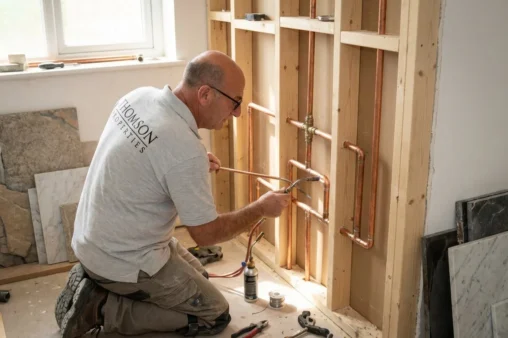
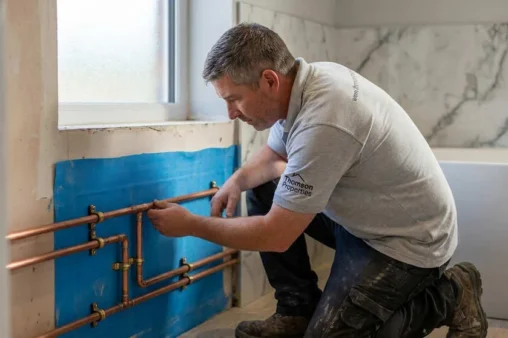
Professional installation costs £6,500-£9,500 + VAT for a comprehensive service in the Cranleigh area. This covers all skilled labour, standard installation materials (pipes, adhesive, plasterboard), and complete rubbish removal.
This figure is for installation only. You purchase the main items separately.
Your mid range bathroom suite, tiles, and finishes add on average £4,000-£8,000+ to the total budget. Mid range kitchen units, worktops, and appliances typically add £8,000-£15,000+ depending on your choices.
The combined investment for a quality bathroom refurbishment usually totals £10,500-£17,500.Kitchen projects typically range £14,500-£24,500+ for the complete transformation. These prices reflect realistic pricing for professional work that lasts.
Understanding what goes into a bathroom refurbishment budget helps you plan accurately from the start. Similarly, knowing realistic kitchen project costs prevents the shock of discovering your budget falls short.
One of our clients, Mr Mills, was apprehensive about renovating his first kitchen. He’d never undertaken a renovation before and had heard nightmare stories about spiralling costs. Our transparent, fixed-price estimate gave him complete certainty. His feedback stated that the project finished exactly on budget with zero surprises.
The Labour-Only Model Explained
We operate a comprehensive installation service, distinct from “supply and fit” packages.
You buy the beautiful items you’ve chosen from any supplier. Complete freedom over aesthetics.
We provide the expert fitting with a price covering labour, standard installation materials, and waste removal.
This model gives you control over your aesthetic budget without being locked into one supplier’s catalogue or inflated material markups.
The trade-off is responsibility. You manage the procurement and delivery timing.
For those who value choice but want installation certainty, understanding labour-only versus all-inclusive quotes clarifies which route suits your priorities.
What Drives Renovation Costs Up (And How to Control Them)
Five specific factors determine where your quote lands in the £6,500-£9,500 range.
Design complexity is the biggest driver. Keeping your sink, toilet and other appliances in their current positions saves significant plumbing work. Moving services requires new pipe runs and waste alterations, potentially adding days of labour to the timeline.
Room size matters directly. Larger spaces need more materials, tiling, and flooring. A compact ensuite naturally costs less than a sprawling family bathroom.
Tile selection impacts labour time substantially. Extra large format porcelain tiles are harder to cut than standard ceramics. Intricate patterns like mosaic or herringbone look stunning but can even triple installation time compared to standard layouts.
Structural changes escalate quickly. Removing walls, creating doorways, or building stud walls for concealed cisterns involves additional time and materials beyond basic refurbishment.
The installer type creates the widest price variation. A sole trader has lower overheads. A professional team provides backup, project management, office support, and continuity—infrastructure that costs money but eliminates significant risks.
Comparing multi-skilled companies versus separate tradesmen reveals how your choice impacts both budget and stress levels throughout the project.
The Hidden Costs That Catch You Off Guard
Budget blowouts rarely happen from quoted work. They happen from discoveries made during the rip-out phase.
Old houses in Surrey and West Sussex often hide secrets beneath the surface.
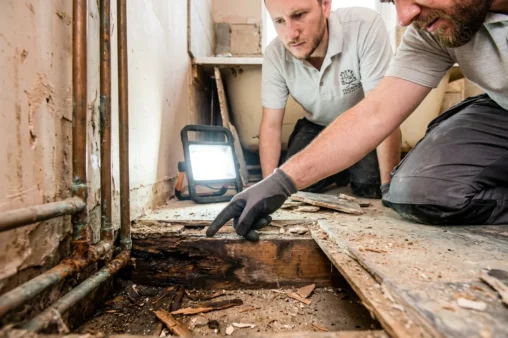
Rotten subfloors from slow leaks are the number one discovery. A tiny, invisible leak from an old shower tray can slowly rot sub floors or timber joists. You cannot tile over a rotten sub floor without creating a future problem. Replacing a ply sub floor would typically cost £500 – £700.
Outdated wiring is common in pre-2000 properties. Modern electric showers and underfloor heating demand higher capacity circuits. Partial rewiring adds several hundred pounds but prevents dangerous overloads. Upgrading the main fuseboard can cost approximately £700 – £900.
Damaged plaster happens when old tiles come off. Removing tiles sometimes tears away large sections of plaster underneath. Re-boarding or re-plastering often costs £150-£450 + VAT depending on the area.
These are legitimate, unavoidable issues. No builder has X-ray vision to see them before the old room is stripped.
The difference between a professional and a cowboy is how they handle the discovery. A trustworthy team stops work immediately, shows you the problem, and provides a written cost for the fix. They only proceed after receiving your written consent. You stay in control of the budget.
Understanding typical hidden extras that push costs higher prepares you mentally and financially for these realistic possibilities.
Set aside 10-15% contingency. For a £20,000 project, keep £2,000-£3,000 in reserve. This isn’t pessimism. It’s prudent planning that prevents panic when discoveries happen.
Payment Structures That Protect You (Avoiding the Deposit Trap)
Payment schedules reveal a company’s integrity more than their marketing ever could.
In our mind, a fair booking deposit is up to 20% of the total project cost. This secures your slot and demonstrates mutual commitment.
Requests for 50% or more upfront are major red flags. This signals cash flow problems or intention to disappear. You lose all leverage once they have your money—what’s their incentive to finish well?
Cash-only demands are even worse. They often indicate tax evasion and leave you with zero paper trail if things go wrong.
Professional companies use stage payments for completed work. You pay as milestones finish, not in advance. Your payments never get ahead of visible progress.
At Thomson Properties, we request a £750 per room booking deposit. The remainder is invoiced weekly for completed stages. Final payment happens only when the job is finished.
Learning what constitutes a fair deposit and payment schedule protects you from financial traps disguised as “industry standard” practices.
| Payment Model | Deposit Amount | When You Pay | Risk Level |
|---|---|---|---|
| Fair (Professional) | <20% or fixed £750 | Weekly for completed work | Low – you stay in control |
| Red Flag | 50%+ upfront | Large sums in advance | High – all risk transfers to you |
| Danger Zone | Cash only, no receipts | Upfront cash lump sum | Extreme – zero protection |
Will This Investment Pay Off? (Understanding Resale Value and ROI)
For Cranleigh’s property market, renovation isn’t just aesthetic. Detached homes averaging £800,000+ attract buyers with high expectations. They’re typically looking for “best in class” finishes, not fixer-uppers requiring immediate work.
A quality kitchen can add 10% to property value. For an £825,000 home, that represents £82,000+ in added value. A premium bathroom typically adds 4-5%, roughly £33,000-£41,000 for the same property.
These aren’t guarantees. They reflect market research for high-value Surrey areas where quality commands premium pricing.
The catch is brutal honesty: budget installations in luxury homes can actively devalue the property. A cheap suite in an £800k house creates a jarring mismatch. Discerning buyers spot it instantly. They often won’t see it as “new”—they’ll see it as work they must redo, deducting that cost from their offer.
“Seen and unseen” quality determines longevity. The tiles and taps are visible. The waterproofing and pipework behind them are invisible. Cheap installations cut corners on the unseen work because you can’t see it. Leaks appear two years later. Survey red flags kill sales or force price reductions.
Discovering whether premium refurbishment genuinely adds value requires understanding your local market expectations and the quality level that meets them.
Richard Leathem, a solicitor in Cranleigh, understood this investment equation perfectly. His professional background in building disputes made him acutely aware of renovation risks. After we completed two bathrooms for him, he described the work as “perfect” and our staff as “genuinely skilled.” His assessment of value was telling: “If you find they are the most expensive quote, they are well worth it.”
He recognised the premium bought him insurance against future problems and quality that protected his property investment.
Why Some Companies Charge More (And What You’re Actually Paying For)
Price differences aren’t arbitrary. They reflect fundamentally different business models and risk allocations.
Sole traders offer the lowest prices because overhead is minimal—one van, one person, no office. They often fall below the VAT threshold, creating an immediate 20% saving compared to VAT-registered companies. The trade-off is a single point of failure. If they’re ill, or their van breaks down, your project stops completely. Or, you become the project manager, coordinating electricians and plasterers yourself.
Professional teams cost more because infrastructure costs money. Employed staff, office support, project managers, comprehensive insurance, and robust guarantees aren’t free. You’re paying for continuity and accountability—if one fitter is unwell, backup normally exists. Dedicated management removes the coordination burden from your shoulders whilst keeping you fully informed.
Luxury design firms charge the most because you’re buying a complete turnkey service. In-house designers, bespoke manufacturing, and full product supply create the ultimate hands-off experience. Budgets often start at £25,000-£60,000+.
Understanding why premium services cost more reveals exactly where your money goes and what each pricing tier actually buys you.
| Provider Type | Typical Cost | What’s Included | Main Risk |
|---|---|---|---|
| Sole Trader | £4,500-£6,500 (no VAT) | Labour only, you manage trades and waste management | Project stops if they’re unavailable |
| Professional Team | £6,500-£9,500 + VAT | Labour, installation materials, waste management | Higher cost but back up guaranteed |
| Luxury Design Firm | £25,000-£60,000+ | Everything – design to installation | Restricted to their suppliers |
How Thomson’s Fixed-Price Model Compares to Industry Standards
We position ourselves in the middle ground between sole traders and luxury firms.
We know we aren’t the cheapest. We’re upfront about that from the first conversation.
Our typical projects cost £6,500-£9,500 + VAT for comprehensive installation service. This reflects the value of infrastructure that eliminates common renovation nightmares: team-based reliability where illness and break downs don’t typically stop your project, professional management so you’re never chasing tradespeople, DBS-checked craftsmen so you feel safe in your home, and a three-year labour guarantee backing the unseen quality behind your tiles.
We operate a comprehensive installation service model. You source your chosen kitchen units or bathroom suite from any supplier. We provide the expert fitting with fixed pricing covering labour, standard materials, and rubbish removal. This gives you freedom without financial uncertainty.
Comparing different quote structures helps you understand which service model aligns with your priorities and risk tolerance.
| Comparison Point | Our Service | Sole Trader | Luxury Firm |
|---|---|---|---|
| Typical Cost | £6,500-£9,500 + VAT | £3,000-£6,000 (no VAT) | £25,000-£60,000+ |
| Team Backup | ✓ Always available | ✗ Single point of failure | ✓ Full team |
| Project Management | ✓ Dedicated managers | ✗ You manage trades | ✓ Full service |
| Product Freedom | ✓ Buy from anywhere | ✓ Buy from anywhere | ✗ Their suppliers only |
| Office Support | ✓ Manned office | ✗ Mobile only | ✓ Full support |
| Labour Guarantee | ✓ 3 years | Variable, often verbal | ✓ Varies by firm |
What Materials Actually Cost (Your Procurement Budget)
Installation is only half the equation. The products you choose create significant budget variation.
For bathrooms, mid-range specifications using quality brands like Burlington, Vitra or Crosswater typically cost £4,000-£7,000. Premium specifications with digital showers and designer brassware range £8,000-£15,000+.
For kitchens, the variables multiply. Units, worktops, and appliances create the widest pricing spread. Standard specifications often cost £8,000-£15,000. Premium specifications with Quartz worktops and integrated appliances reach £15,000-£30,000+.
Where you buy matters significantly. Local showrooms typically charge more than online retailers. The trade-off is immediate support versus delayed problem resolution.
Exploring local showrooms versus buying online reveals how procurement choices impact both budget and project continuity.
Luxury specifications deserve separate consideration. Understanding what actually defines luxury installation and whether the premium delivers tangible benefits helps you decide where to allocate budget.
The “Cheap Quote” Reality (What Gets Cut to Lower Price)
Every quote involves trade-offs. Lower prices almost always mean something gets reduced or eliminated.
Cheaper quotes often exclude essential installation materials. Tile adhesive, grout, copper pipework, and timber aren’t included. These “boring” necessities add £800+£3000 to your final bill as surprise extras.
Waste removal frequently appears as an afterthought. The skip fee of £200-£500 hits you at project end when you’re least expecting it.
Tidiness standards often drop dramatically. Budget operators view daily cleaning as wasted billable time. Your home becomes a building site.
The unseen work suffers most critically. Waterproofing gets skipped to save a few hours labour and the material costs. Pipework installation rushed to meet the next job deadline. Sub-walls and sub-floors not strengthened or replaced where necessary.These corners cut today become £10,000+ leak repairs in two years.
Professional standards cost time. Meticulous tanking, pressure-testing every joint, and perfect substrate preparation take longer than rushing. You’re paying for work that prevents future disasters, not just work that looks acceptable today.
The Unforeseen: Planning for Discoveries
Renovation in older properties involves inherent uncertainty. You cannot see inside walls until they’re opened.
Cranleigh’s housing stock includes many Victorian and Edwardian properties hiding issues that only appear during demolition.
Rotten joists from historic leaks appear in roughly one in four bathroom renovations we undertake. The timber must be replaced—ignoring it means your new floor starts to get “hair line” cracks in grout lines within months.
Ancient wiring that is unsafe or lacks RCD protection cannot safely power modern electric showers or underfloor heating. Partial rewiring becomes mandatory for safety and building regulations compliance.
These aren’t “extras” added to inflate bills. They’re genuine problems requiring attention for your safety or to ensure the best outcome for your project.
Our Charter Document protocol is strict. We stop work when significant issues appear. We inform you immediately with photos or video, provide a written quote for the specific repair, and proceed only after receiving your written consent. You remain in control, never ambushed by surprise invoices.
Detailed exploration of hidden extras that catch homeowners prepares you mentally and financially for realistic contingencies.
Budget 10-15% contingency. For a £20,000 project, keep £2,000-£3,000 in reserve. This transforms potential panic into confident preparation.
Why DIY Buyers and Bargain Hunters Should Look Elsewhere
Radical honesty requires admitting we’re not right for everyone. If the fit isn’t there, we’d rather tell you now.
Our service is NOT for you if your absolute priority is the lowest possible price. If budget is your only consideration, a sole trader will undercut us. We cannot compete with someone working from a van with no employees. Our infrastructure costs prevent rock-bottom pricing.
We’re NOT for you if you want zero involvement. Our comprehensive installation model requires you to source the main items. If you want one company to choose everything for you, a full design-and-supply firm is better suited.
We’re NOT for you if you’re flipping properties for quick sale. The premium we charge for unseen quality may not recoup fast enough. Cosmetic updates might be financially smarter for investment flips.
We’re NOT for you if you enjoy project managing trades. If coordinating plumbers and electricians doesn’t stress you, hiring separate specialists saves money. Our managed service offers more support than you require.
Who we ARE for: those who value their time and home, are willing to invest in certainty over bargains, and want to sleep soundly knowing the team will show up tomorrow and the budget won’t explode.
Frequently Asked Questions About Renovation Costs
Do your prices include VAT?
Our labour estimates are quoted plus VAT. We always make this crystal clear on the estimate so you know the exact total.
What if you find rotten floorboards during the rip-out?
We stop work and show you the problem. We provide a written quote for the specific repair and only proceed with significant work after receiving your written consent. You stay in control of the budget.
Why do quotes vary so much between companies?
You’re rarely comparing like-for-like. A sole trader quote normally covers basic labour only. A team quote includes project management, an office team, installation materials, waste removal and backup. A luxury firm quote includes design and all products. The scope differs massively.
Is finance available for renovations?
We don’t offer direct finance. Many use personal savings, home improvement loans, or extend their mortgage. Your bank or independent financial advisor can discuss options suited to your circumstances.
How do I know if your estimate is fair?
Compare our detailed breakdown against others. Check we’ve included labour, installation materials, and waste removal. Verify we’ve explained our process for unforeseen costs. Ask previous clients if the final bill matched the quote.
The 3-Step Vetting Process Before Signing Any Renovation Contract
You now understand what drives renovation costs in Cranleigh and the surrounding Surrey villages. You know realistic budgets, hidden extra warnings, and payment structures that protect you.
Step 1: Calculate your realistic total budget. Combine professional installation costs with your preferred material specification. Add your contingency reserve. This creates your working budget ceiling before you commit.
Step 2: Compare quotes on scope, not just price. Check what’s included in each estimate—materials, waste removal, project management, guarantees. The cheapest number often hides the most extras and risks.
Step 3: Verify credentials and ask for references. Check memberships, insurance, and guarantees. Speak to previous clients about whether final costs matched estimates.
If you’re in Cranleigh or the surrounding areas and want a detailed, transparent quote for your specific project, we’re here to help. We offer free, no-obligation estimates where we discuss your vision and provide comprehensive pricing breakdowns.
Call us now on 01483 272440 or email info@thomson-properties.com to book your consultation.
No pressure. No sales pitch. Just honest advice to help you plan confidently.
All Articles in This Guide
Budget Planning & Realistic Costs
What is a realistic budget for a quality bathroom refurbishment in Cranleigh? Complete breakdown of installation costs, material budgets, and total investment ranges for Surrey bathroom projects.What is a realistic budget for a full kitchen refurbishment in Cranleigh? Detailed cost analysis covering labour, materials, and the five key factors that push kitchen budgets higher or lower.Understanding True Costs & Hidden Expenses
What are the typical hidden extras that push renovation costs higher? The legitimate unforeseen issues versus illegitimate vague charges, plus how professional companies handle discoveries transparently.What is a fair deposit and payment schedule for a renovation? Protect yourself from the deposit trap by understanding industry norms versus red flag warning signs.Investment Value & ROI
Will premium refurbishment add meaningful resale value in Cranleigh? Honest analysis of ROI potential for Surrey’s property market and when budget installations actively devalue premium homes.
Service Models & Price Comparisons
Labour-Only vs. All-Inclusive: Which quote structure is right for you? Compare the freedom of labour-only models against the convenience of full-service packages to understand which suits your priorities.Multi-skilled company vs. separate tradesmen: Which costs less long-term? The true cost comparison including hidden project management time and risk premiums you absorb with separate trades.Why we aren’t the cheapest: What goes into premium pricing Transparent breakdown of infrastructure costs, team investment, and why competing purely on price compromises quality.Procurement & Value Strategies
Local showroom vs. buying online: Which offers better value? Honest comparison of upfront savings versus support quality and how procurement choices impact project timelines.What defines luxury bathroom installation and is it worth the cost? Breaking down premium specifications, unseen quality investments, and when luxury features genuinely justify their price tags.