We know from experience that planning a new family bathroom often involves a tug-of-war between your heart and your head.
Your heart likely wants the stunning, open-plan “hotel look” of a wet room because it feels luxurious, spacious, and modern.
But your head is probably asking the tough, practical questions about whether it will actually work with three kids splashing around at 7 am or if the floor will be slippery.
At the end of the day, a bathroom in a busy family home isn’t just a showroom piece. It has to function under the pressure of your home.
To help you decide, here are the core trade-offs you need to weigh up before making that final decision for your home.
Key Takeaways
- Safety Trade-off: Wet rooms eliminate trip hazards at the entrance, making them superior for accessibility, but they increase the risk of slips on wet floors compared to enclosures which contain water effectively.
- Practicality Reality: Traditional enclosures pass the “soggy sock test” by keeping the rest of the room dry, whereas wet rooms require disciplined water management to prevent damp towels and toilet rolls.
- Installation Complexity: Wet rooms require more “tanking” (comprehensive waterproofing) and structural floor gradients, making them a complex construction task compared to the “fit and forget” nature of a tray.
- Cost Implications: Due to additional specialist labour and materials required for waterproofing, a wet room will almost always cost significantly more than a standard shower enclosure.
1. Safety: Accessibility vs. The Risk of Slips
When you have young children, or perhaps older relatives staying with you, safety is usually the top priority.
Both options have distinct advantages here, but they address different risks in very different ways.
The biggest safety benefit of a wet room is undoubtedly accessibility. By eliminating the shower tray and creating a level, barrier-free entry, you remove the trip hazard entirely.
This makes it ideal for young children who might trip over a step, and it is excellent for elderly family members with mobility issues.
However, because there is no tray to catch the water, the floor outside the immediate shower area can get wet. This introduces a slip hazard if the wrong tiles are chosen.
If you choose a wet room, selecting the right flooring is non-negotiable.
We always advise using tiles with a high slip-resistance rating (R11 or higher) or specialised vinyl to ensure that even when the floor is wet, it remains safe for little feet.
In contrast, a traditional enclosure creates a physical barrier. The tray and glass screens keep the water contained within a specific zone, meaning the rest of the bathroom floor remains dry and safe to walk on in socks.
This reduces the risk of someone slipping when they just pop in to use the basin or toilet.
The downside is that there is usually a step up into the tray. While modern low-profile trays are much lower than they used to be, they still present a small obstacle that can be a trip hazard for the very young or less mobile.
2. Practicality: The “Soggy Sock” Test
If you walk into the bathroom ten minutes after your teenager has showered, will your socks get wet?
In a wet room, unless the room is huge, water spray can travel. Without a door to contain it, steam and splashes can leave towels damp, toilet rolls soggy, and vanity units wet.
In a busy morning routine, having to squeegee the entire floor so the next person can use the room without getting wet feet can become a frustration.
A traditional enclosure excels here. It keeps the warmth, steam, and water inside the cubicle. The rest of the room stays dry, warm, and immediately usable for other family members.
There is also a common misconception that wet rooms are easier to clean because there is “less to clean.”
It is true that you don’t have the nooks and crannies of a shower door runner, which can trap grime. However, you can have a lot more grout.
You will likely be scrubbing more grout lines on the floor, which can discolour over time, and textured non-slip tiles can often be harder to mop than a smooth shower tray.
With an enclosure, you have glass to squeegee and seals to keep clean, but the tray itself is essentially a wipe-down surface.
3. Installation and the “Unseen” Risks
This is where we have to be perfectly honest about the complexity of the work.
The difference in installation between a wet room and an enclosure is like chalk and cheese.
Installing a wet room is a significant construction task. We have to create a gradient in your floor so water drains away, which often involves structural work to the joists.
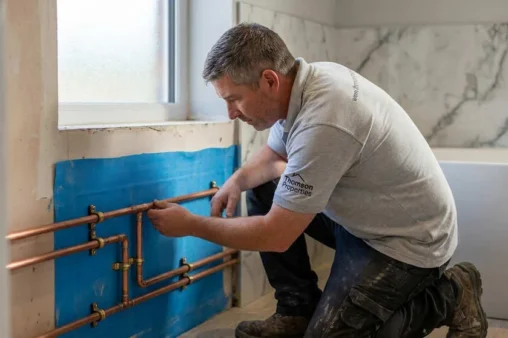
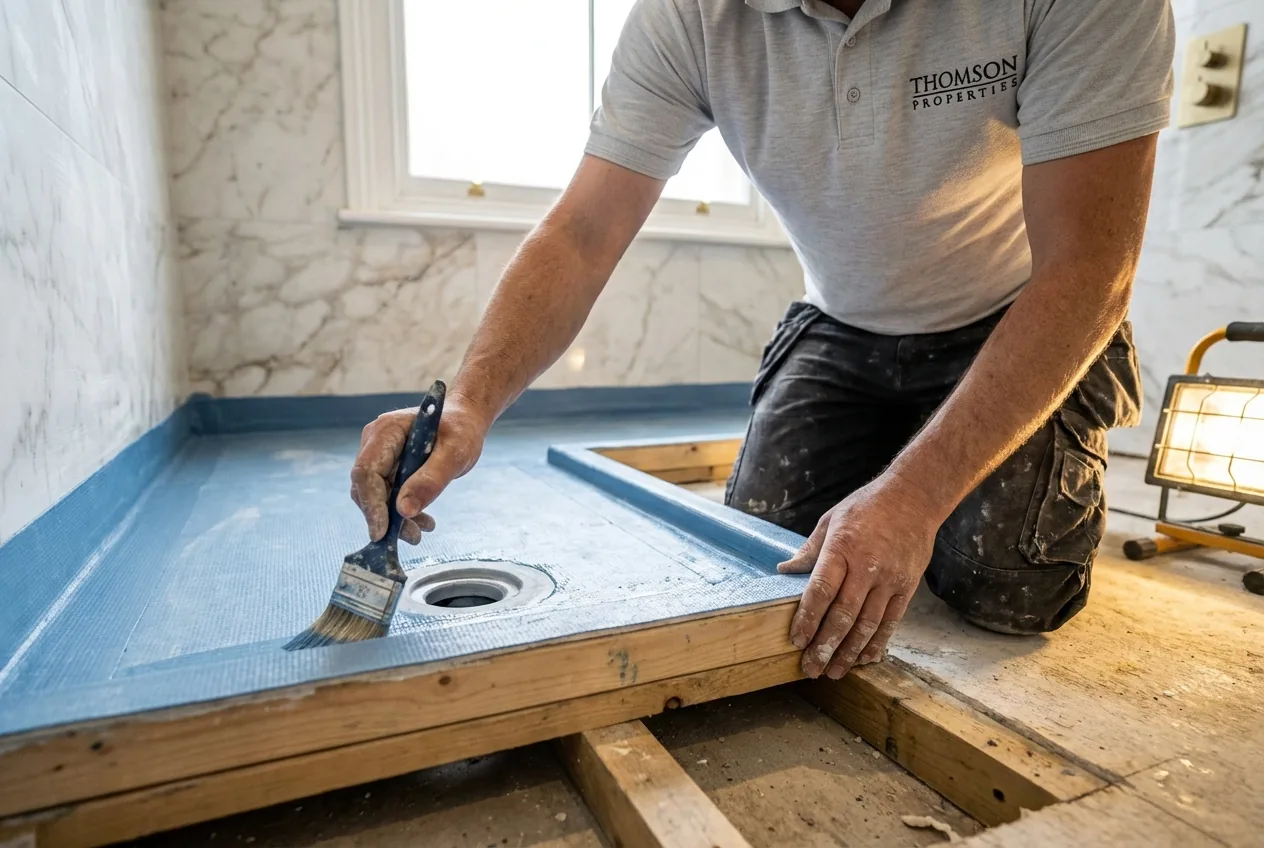
Most importantly, the entire room (or a large section of it) must be “tanked.” This involves applying a waterproof membrane under the tiles to stop water from leaking into the structure of your home.
If this “unseen” work is done poorly, the consequences can be disastrous.A leak in a wet room can go unnoticed for months, rotting floorboards and damaging ceilings below.
This is why we place such a huge emphasis on “seen and unseen quality” and use specific, high-quality waterproofing systems to guarantee this doesn’t happen.
Conversely, a shower tray is a factory-sealed unit designed specifically to hold water.
Provided the plumbing waste is fitted correctly, the risk of a structural leak is significantly lower. It is a simpler, faster installation that carries less inherent risk for the homeowner.
4. The Honest Cost Comparison
We believe in radical transparency regarding pricing. Because a wet room requires more specialist labour and materials, it is the more expensive option.
The primary driver for this higher cost is labour. It takes considerably longer to structurally alter the floor, create the necessary gradients, and meticulously apply the tanking system compared to fitting a tray.
You also need to budget for specific materials, such as a specialist tanking kit and drain system.
With an enclosure, the tray simply sits on the floor. There is no need to waterproof the entire floor area or alter structural joists in the same way.
Our team can install a tray and enclosure much faster, reducing the labour cost on your estimate.
To give you a rough idea, a full wet room installation can cost significantly more than a standard refurbishment involving a tray and enclosure.
If budget for a quality bathroom is a primary driver, the enclosure is the clear winner.
5. Which is Right for Your Family?
To help you decide, here is a summary of who each option is best suited for.
Option A: The Wet Room is a good fit for you if:
- You prioritise accessibility: You need a barrier-free space for elderly relatives or those with mobility needs.
- You want the “wow” factor: You are looking for a high-end, minimalist aesthetic that adds value to your home. Is it worth the investment? For many, the seamless look and feel are priceless.
- You have a higher budget: You are happy to invest in the specialist labour and materials required for a safe installation.
- You are happy to manage the water: You don’t mind using a squeegee on the floor after a shower.
This is NOT a good fit for you if you are on a tight budget, as the extra labour and tanking costs might not offer the best value.
It is also not ideal if you hate wet floors. If stepping onto a damp floor in socks annoys you, a wet room in a small family bathroom will be a frustration.
Finally, if you are worried about leaks, unless you hire a specialist team you can implicitly trust, the risk of leaks is inherently higher than with a tray.
Option B: The Traditional Shower Enclosure is a good fit for you if:
- You have a busy household: You need the bathroom to be dry and usable by multiple people in quick succession.
- You want a lower-risk installation: You prefer a “belt and braces” approach to water containment.
- You are budget-conscious: You want a beautiful bathroom but want to spend your budget on high-quality fixtures rather than structural floor alterations.
- You need to avoid damp floors: If stepping onto a damp floor in socks annoys you, a wet room in a small family bathroom will be a frustration.
This is NOT a good fit for you if you need zero-threshold access, as even low-profile trays have a small lip that can be a trip hazard.
It is also less suitable if you hate cleaning glass, as enclosures typically have more glass and chrome that require regular wiping to keep them looking sparkling.
Our Expert Recommendation
From our experience working with families across Surrey and West Sussex, we find that for a main family bathroom, a high-quality, low-profile shower enclosure is often the most practical choice.
It offers the best balance of safety (dry floors), practicality (water containment), and cost.
Take Philip in Guildford, for example. He had an old, tired shower room that he desperately wanted to convert into a sleek, modern ensuite. He loved the idea of that open, luxurious “hotel look” you get with a wet room, but he needed the space to be functional for daily use without soaking the entire room.
We installed a high-end enclosure for him instead. The result was exactly what he hoped for.
He told us that visitors frequently comment that “it looks like a hotel bathroom.” He achieved that aspirational aesthetic he wanted, but with the practicality of a contained shower unit.
However, if you are creating a secondary bathroom, a downstairs shower room, or a luxury en-suite, a wet room is a fantastic option that adds a real touch of luxury and future-proofs your home for accessibility.
Whichever you choose, the quality of the installation is what matters most.
A wet room is only as good as the waterproofing beneath the tiles, and an enclosure is only as good as the plumbing behind the wall.
That is why we offer a three-year labour guarantee on all our work. We hire for character and train for skill, ensuring the team working in your home cares just as much about the “unseen” quality as they do about the final finish.
If you are in Cranleigh or the surrounding areas and want to discuss which option would work best for your specific bathroom layout, we are here to help. Give us a call for a friendly chat and a free, no-obligation estimate.